

Exploring Archival Cartoons
The golden age of magazine cartooning produced a wealth of artistic treasures that captured the spirit, humor, and social commentary of their times. Talented illustrators filled the pages of popular publications with single-panel cartoons that reflected everything from changing social norms to the absurdities of daily life. These works offer us a unique window into the past, revealing not just what made people laugh, but what they worried about, aspired to, and found noteworthy in their rapidly changing world.
This ongoing series exploring archival cartoons aims to rediscover and celebrate these iconic gems of cartoon art. Each featured piece tells a story not just through its humor, but through its artistic style, cultural context, and the pioneering spirit of the artists who created them. Many of these cartoonists worked during an era when the field was far less diverse than today, making their contributions all the more significant. By exploring these works across different eras and cultures, we can trace the evolution of humor, social attitudes, and artistic expression through some of the most dynamic periods in modern history.
1920’s
Barbara Shermund
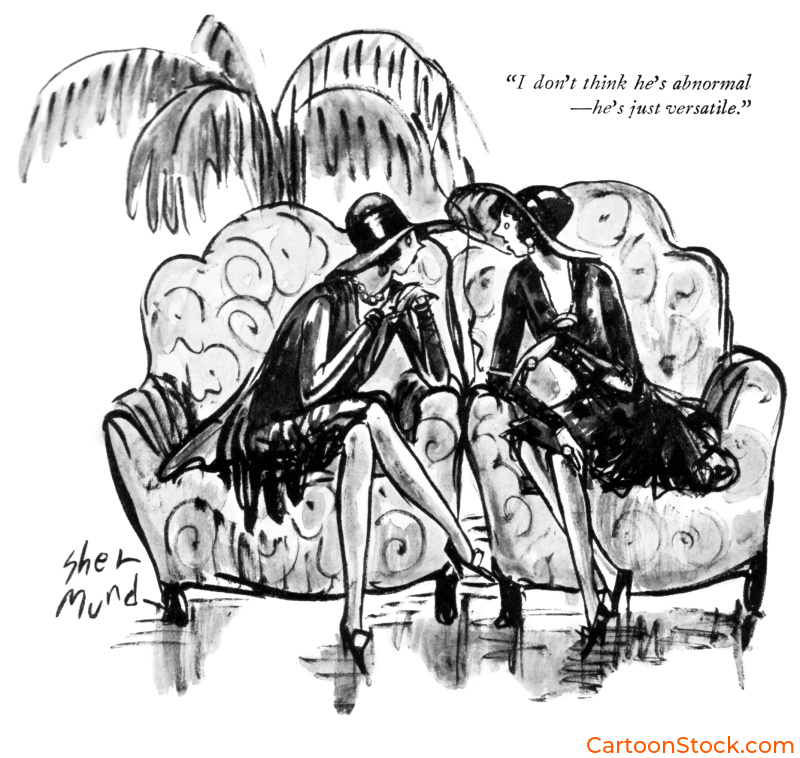
Published in: The New Yorker (21/07/1928)
Barbara Shermund was a pioneering female cartoonist who made her mark during the golden age of American magazine illustration. At a time when the field was overwhelmingly dominated by men, Shermund carved out a distinctive niche with her witty single-panel cartoons that often appeared in popular magazines of the era. Her work was characterized by sharp social observation and a keen eye for the absurdities of everyday life.
Shermund’s cartoons frequently explored themes of modern urban life, relationships, and social conventions with a satirical edge that resonated with magazine readers of her time. Her artistic style combined clean linework with expressive character work, allowing her to convey humor and social commentary with economy and precision. As one of the relatively few women working professionally as a cartoonist during this period, Shermund helped pave the way for future generations of female cartoonists while contributing to the rich tradition of American magazine cartooning that flourished in the early to mid-20th century.
Explore more work by this cartoonist in her Artist Spotlight post
1930’s
James Thurber
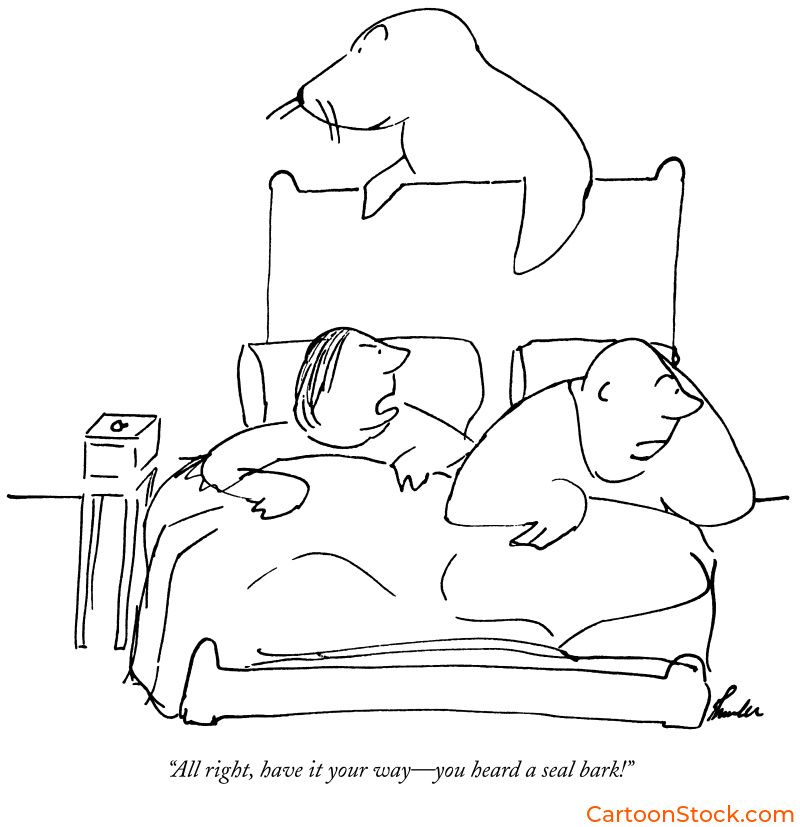
Published in: The New Yorker (30/01/1932)
This cartoon was published during James Thurber’s early years as a regular contributor to The New Yorker, where he worked as both writer and artist. By the early 1930s, his cartoons had begun to appear with some frequency, helping to define the magazine’s tone: understated, literary, and visually unconventional.
The drawing is a typical example of Thurber’s style. His characters are rendered with minimal, almost primitive lines—an aesthetic shaped in part by his declining vision. Thurber lost most of the sight in one eye during a childhood accident, and his eyesight continued to deteriorate throughout his life. As a result, many of his cartoons were drawn in black crayon or pencil on oversized paper, then resized for publication by the magazine’s art department.
This cartoon uses a simple two-character scene with a visual absurdity—the seal on the headboard—introduced without narrative buildup. That approach was common in Thurber’s work. He frequently combined ordinary domestic scenarios with surreal elements, often leaving their presence unexplained. These cartoons appeared alongside his essays and short fiction, contributing to his reputation as one of the defining voices of The New Yorker in its formative decades.
Find out more and see his exclusive content
1940’s
Richard Taylor
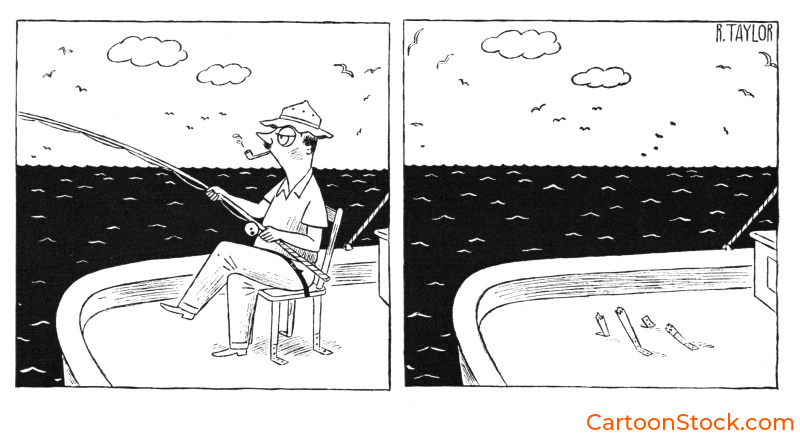
(No caption — but you get the point.)
Published in: The New Yorker, 1941
Richard Taylor began contributing to The New Yorker in 1935, becoming one of the magazine’s most distinctive cartoonists during its golden age. Born in Fort William, Ontario, in 1902, Taylor had worked his way through the Canadian newspaper and magazine industry before Simon & Schuster brought him to New York to join the magazine’s stable of artists.
Taylor’s cartoons were immediately recognizable by their unique visual signature: characters with distinctive “poached egg eyes” featuring heavy, low-hanging eyelids, and backgrounds rendered with unusual blocks of parallel lines. His drawing technique was precise yet stylized, creating a world that felt both sophisticated and slightly off-kilter—perfectly suited to The New Yorker’s urbane sensibilities.
Unlike some of his contemporaries who focused on domestic humor, Taylor often depicted the anxieties and pretensions of middle-class social life. His cartoons appeared regularly in the magazine alongside work by contemporaries like Charles Addams and Peter Arno, helping to establish the publication’s reputation for sharp, observational humor. Taylor’s work also appeared in other major publications including Collier’s, The Saturday Evening Post, and Esquire, making him one of the most widely published cartoonists of his era. He continued contributing to The New Yorker until his death in 1970, leaving behind a body of work that influenced a generation of cartoonists and helped define American magazine cartooning during its most influential period.
Syd Hoff
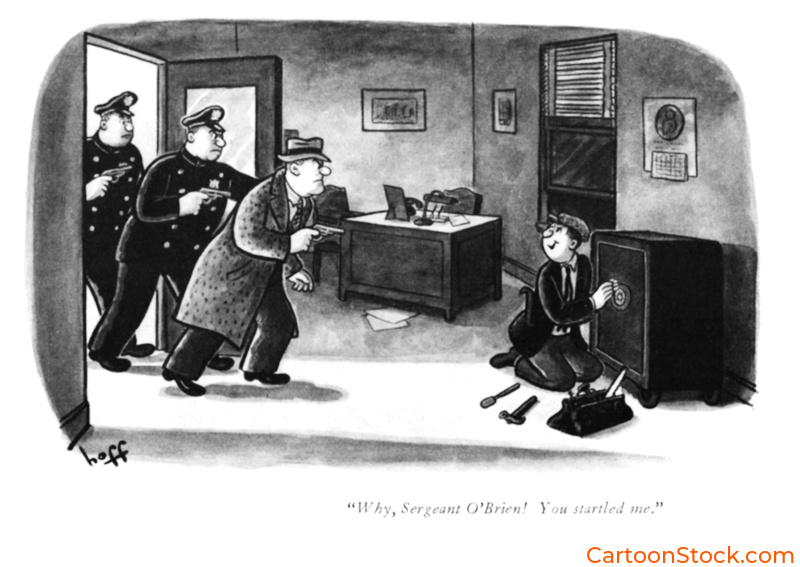
Published in: The New Yorker, (23/12/1944)
Born in the Bronx in 1912, Syd Hoff attended the National Academy of Design and sold his first cartoon to The New Yorker at eighteen, deciding then and there to give up serious painting for cartooning. By early 1932, publisher Harold Ross had dubbed him the “Bronx Correspondent” for his humorous renderings of tenement life — a career with the magazine that would ultimately span more than four decades.
Hoff’s style was built on economy. A few confident lines, expressive faces, and an instinct for the telling detail. He drew ordinary people in ordinary situations, then introduced one small thing that was not ordinary at all. This cartoon is a good example: a man facing arrest who responds as though he has merely been interrupted at a filing cabinet.
During the war years, when this cartoon was published, he joined the Office of War Information and drew propaganda cartoons dropped behind enemy lines — his syndicated comic strip Tuffy having been declared “essential for national morale.” Alongside his New Yorker work, he had also been contributing cartoons to leftist publications under the pseudonym A. Redfield, work that later drew the attention of the FBI. He kept the two careers carefully apart.
He is perhaps best remembered today as the author of Danny and the Dinosaur (1958), which sold ten million copies. But his magazine work came first, and it remains a distinct body of achievement — nimble, warm, and grounded in the textures of city life.
1950’s
Mischa Richter
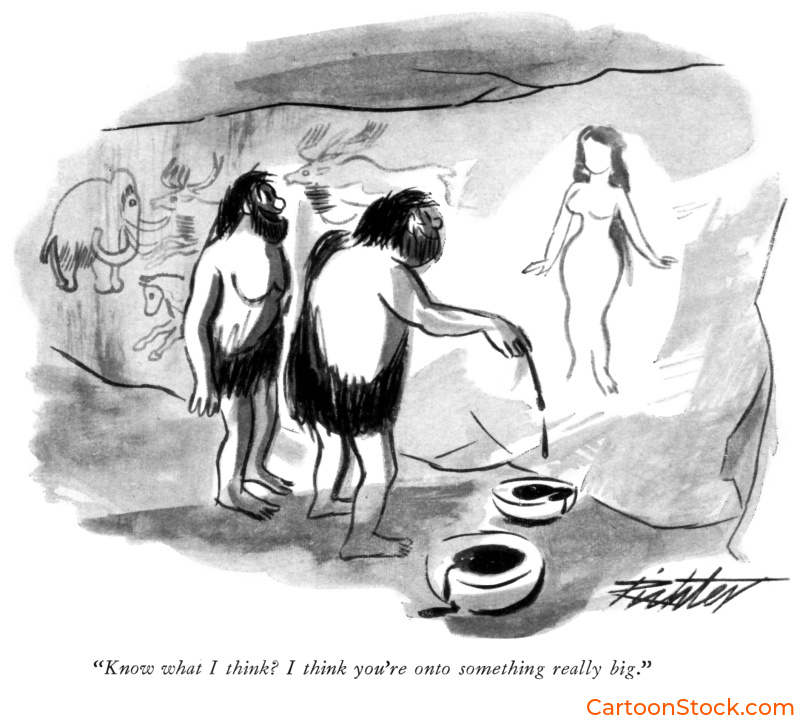
(Published in: The New Yorker 1956)
Mischa Richter brought a sophisticated European sensibility to American magazine cartooning during his prolific five-decade career. Born in Kharkiv, Ukraine, in 1910, Richter immigrated to the United States as a child and studied painting at the Boston Museum School of Fine Arts before turning to cartooning in the early 1940s. He became one of The New Yorker’s most frequently published cartoonists, contributing over 1,600 cartoons to the magazine between 1941 and his death in 1988.
Richter’s visual style was immediately distinctive: bold, confident brushwork combined with a painter’s eye for composition and design. His characters were rendered with fluid, expressive lines that gave them personality and weight, while his backgrounds often featured dramatic use of solid blacks and simplified forms. Unlike cartoonists who relied heavily on caption-driven humor, Richter excelled at visual storytelling, frequently creating cartoons where the image carried much of the comedic impact.
His subject matter ranged widely, from domestic situations and office life to social commentary and surreal scenarios, always executed with intelligence and wit. Richter’s work appeared not only in The New Yorker but also in Collier’s, Look, and This Week magazine, making him one of the most visible cartoonists of the postwar era. His influence extended beyond his own work—he mentored younger cartoonists and helped define the sophisticated visual humor that became synonymous with mid-century magazine cartooning.