

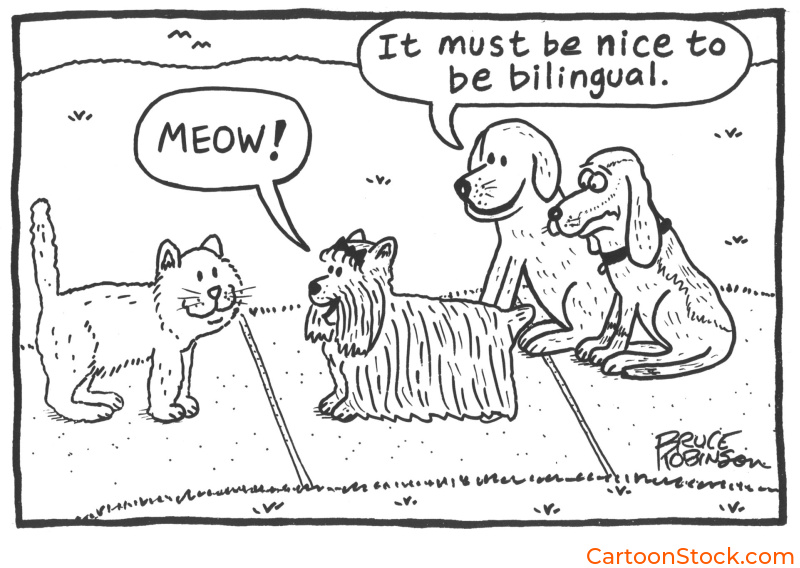
The Language Question
One of the quiet worries international cartoonists carry into licensing is language.
Do cartoons need to be in English to sell? Will captions limit where work can be used? Does working in a non-English language shrink the market before it even begins?
Multilingual licensing exists precisely to remove those constraints. However, it doesn’t work by erasing language—it works by supporting it.
Part of our International Cartoon Licensing: A Complete Guide for Artists Worldwide guide
Visual Humor Travels First
Cartoons are, at their core, visual communication. Before a caption is read, the idea has already landed—or it hasn’t.
That’s why cartoons are uniquely suited to cross-border licensing. A strong visual metaphor, a recognizable human situation, or a clear emotional beat often makes sense across cultures long before text enters the picture.
Language matters, but it is rarely the primary barrier to understanding. In fact, in licensing, visuals do most of the heavy lifting. This is why cartoon licensing platforms focus on visual discoverability first, with language as a secondary layer.
How Multilingual Licensing Actually Works
Multilingual cartoon licensing doesn’t require artists to work in multiple languages, or to adapt their voice for different markets.
Instead, platforms handle the mechanics of reach. On platforms like CartoonStock, cartoons are discoverable across multiple languages, allowing buyers to search for ideas in their own words. Captions can be translated where appropriate, while the original intent and tone of the cartoon are preserved.
This means artists can submit work in their native language, buyers can discover cartoons without sharing that language, and the cartoon’s reach expands without the artist needing to intervene.
Multilingual capability increases discoverability—it doesn’t rewrite the work. Moreover, it removes the burden of managing international markets independently.

Submitting in Your Native Language Is Not a Disadvantage
A common misconception is that submitting cartoons in English is a prerequisite for global licensing. It isn’t.
Cartoonists create strongest work when they write naturally. Awkward translation at the point of creation often weakens clarity rather than improving reach. Therefore, forcing yourself to work in a second language can actually reduce the effectiveness of your humor.
Licensing platforms are designed to support native-language submissions, ensuring that work can still be found by international buyers. Consequently, the cartoon remains the same; only the pathway to discovery changes.
This approach is particularly valuable for cartoonists whose work includes culturally specific references that might lose meaning in premature translation.
Why Translation Supports Discovery, Not Conformity
Translation in multilingual cartoon licensing is functional, not creative.
Its role is to help buyers find relevant cartoons—not to standardize humor or flatten cultural nuance. The original cartoon remains intact. Instead, translation simply ensures that someone searching for an idea in German, French, Italian, or Japanese has a chance of encountering work created elsewhere.
This distinction matters. Multilingual licensing doesn’t ask artists to make their humor universal. Rather, it allows specificity to travel without losing its essential character.
Additionally, this is why platforms translate search terms and metadata rather than rewriting cartoon captions to “appeal” to different markets. The goal is connection, not conversion.
A Broader Market Without a Broader Burden
For individual cartoonists, managing multiple languages independently would be impractical. That’s precisely the friction platforms are designed to remove.
By handling language access centrally, licensing platforms widen the potential market without increasing the artist’s workload. The same cartoon can be relevant in different regions at different times, depending on context, news cycles, or cultural moments.
Reach expands quietly, without requiring the artist to anticipate where or when interest will emerge. Furthermore, this is how the long-tail licensing model works across borders—unpredictable demand in multiple markets, supported by consistent availability.
Ready to reach a global audience with your cartoons?
CartoonStock licenses work from artists worldwide — find out how our platform works, what we look for, and how to get your cartoons in front of the right buyers.
Your Global Advantage as an International Cartoonist
International cartoonists are often closer to cultural perspectives that buyers actively seek—precisely because they are not centered in the same media environments.
Multilingual cartoon licensing allows those perspectives to circulate without being filtered or simplified. Instead of asking artists to adjust their work to fit a dominant language or market, the system adapts around the work.
The result is not universality, but access. Moreover, this is where international cartoonists have a competitive advantage rather than a disadvantage—you bring perspectives that cartoonists in English-speaking markets simply don’t have.
Language Is a Layer, Not a Barrier
In cartoon licensing, language is one layer of communication—not a gatekeeper.
Strong ideas remain strong across borders. Multilingual licensing simply ensures that those ideas can be discovered by the people looking for them, wherever they happen to be searching.
For international cartoonists, this isn’t about translating yourself into someone else’s market. Rather, it’s about letting your work exist in more than one place at once.
Q&A: Common Questions About Multilingual Cartoon Licensing
Q: Does CartoonStock translate my cartoon captions automatically?
CartoonStock offers multilingual search capabilities across seven languages, allowing buyers to discover cartoons in their native language. Caption translation is handled on a case-by-case basis depending on licensing needs, but you always submit work in your native language. The platform manages translation infrastructure so you can focus on creating cartoons, not managing international versions.
Q: Will my cartoon lose its humor if the caption is translated?
Not necessarily. Translation in multilingual cartoon licensing focuses on conveying the core idea rather than word-for-word conversion. Additionally, many cartoons rely primarily on visual humor, where the caption supports rather than carries the joke. For caption-dependent cartoons, platforms work to preserve the intended tone and meaning rather than producing literal translations that might fall flat.
Q: Do I need to create different versions of my cartoons for different markets?
No. One of the main benefits of multilingual cartoon licensing is that you create the cartoon once, in your native language, and the platform handles discoverability across markets. You don’t need to anticipate different cultural contexts or create multiple versions. The licensing model works because diverse perspectives find their audiences naturally, not through artificial adaptation.
Keep Reading
Wondering if your culturally specific cartoons will actually appeal to international buyers?
Read: Why Culturally Specific Cartoons Sell Better Than You Think
Related Posts
How Cartoon Licensing Platforms Work for International Artists
Will Your Cartoons Sell? Why Diversity Drives Long-Tail Licensing
Licensing as a Long-Term Strategy for International Cartoonists