

Workplace training isn’t one size fits all, especially when it comes to supporting neurodiverse employees. Traditional learning materials can leave people with ADHD, autism, dyslexia, and other cognitive differences overwhelmed, confused, or excluded. That’s where visual tools like cartoons come in. By combining clarity, empathy, and a dose of humor, cartoons can play a key role in building neurodiverse-friendly workplace training that actually works.
Cartoons are more than just funny pictures. They’re a strategic way to make your training materials more inclusive, engaging, and effective for everyone, especially those who think differently.
Explore this topic in more detail using our full guide Using Cartoons to Support Diversity, Inclusion & Belonging
Why Standard Training Often Fails Neurodivergent Employees
PowerPoint decks full of text. Wordy policy documents. Long videos with no breaks. These standard formats can pose major challenges for neurodivergent team members.
People with ADHD may struggle with sustained attention and information overload. Autistic employees might find overly abstract content difficult to interpret, while dyslexic learners can feel shut out by dense paragraphs of unstructured text.
Neurodiversity is about variation in cognitive function, not deficiency. But when training isn’t designed with that variation in mind, it can reinforce exclusion.
That’s where neurodiverse-friendly workplace training makes a difference. It anticipates diverse processing styles and adapts accordingly.
What Makes Training Neurodiverse-Friendly?
Inclusive training design focuses on making information:
- Visually clear
- Easy to navigate
- Engaging without being overwhelming
- Flexible for different attention spans and processing speeds
That doesn’t mean dumbing things down. It means making information accessible and memorable.
Some key practices include:
- Using short-form content and modular structure
- Avoiding jargon and abstract metaphors
- Breaking text into digestible pieces
- Providing visual cues or summaries
And yes, incorporating well-designed cartoons.
How Cartoons Support Neurodiverse-Friendly Workplace Training
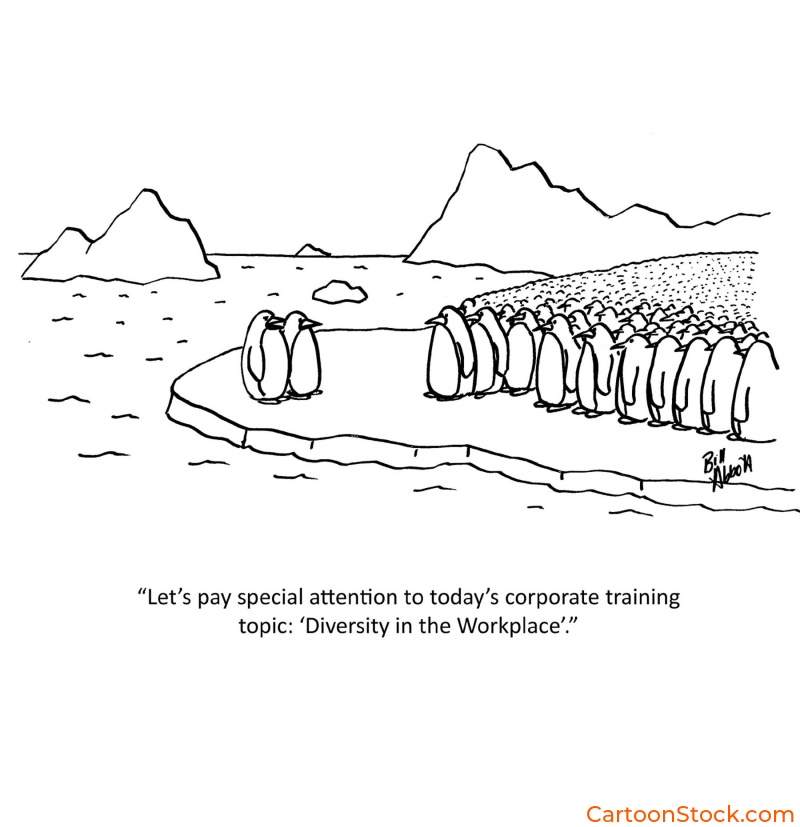
One great example of this is the cartoon featured at the top of this article. It shows a group of penguins, almost indistinguishable from one another, gathered for a corporate training session titled “Diversity in the Workplace.” The humor lies in the irony: a visually homogeneous group discussing diversity. This cartoon works on multiple levels. It immediately communicates the concept of performative inclusion, encourages reflection, and invites discussion without needing a single bullet point or paragraph of text.
Used in a training setting, this cartoon could serve as a memorable opener, a springboard for group discussion, or a prompt in a DEI workshop. It’s a perfect example of how cartoons can add nuance, humor, and visual engagement to even the most sensitive or complex workplace topics.
Visual storytelling is a powerful tool for comprehension. For visual thinkers, which includes many neurodivergent individuals, a cartoon can make a concept click faster than paragraphs of explanation ever could.
Cartoons help by:
- Turning abstract ideas into concrete images
- Making serious topics feel approachable
- Offering visual context for nuanced scenarios (like ethics or DEI)
- Reducing reading load while maintaining clarity
Because cartoons distill key messages into bite-sized visual moments, they’re naturally well suited for microlearning and asynchronous formats.
Cartoons also offer humor, which helps with emotional regulation and memory retention. That’s especially helpful when navigating sensitive or complex training topics.
Tips for Using Cartoons Effectively in Your Training Materials
Here’s how to get the most value out of cartoons in a neuroinclusive learning environment:
1. Pair Visuals with Plain Language
Even a great cartoon works best when supported by a clear, simple caption. Avoid idioms or overcomplicated explanations.
2. Choose the Right Cartoon Style for the Topic
Some topics need warmth and empathy. Others call for irony or satire. Match the cartoon tone to your message.
3. Avoid Overcrowding the Page
One cartoon per concept is usually enough. Let the visual breathe and avoid burying it in dense text.
4. Use Cartoons to Reinforce, Not Replace
Think of cartoons as guideposts that support the message. They help reinforce core ideas without overwhelming the learner.
5. Ensure Accessibility
Add alt-text to every image, and make sure color contrast meets accessibility standards.
Why CartoonStock Works for Inclusive Workplace Visuals
Our archive is curated with communication in mind. Whether you’re building onboarding modules, compliance training, or DEI workshops, you’ll find a wide variety of cartoon styles and topics to support your message. Many customers creating neurodiverse-friendly workplace training use CartoonStock to:
- Source visual metaphors that clarify abstract concepts
- Lighten the tone of heavy material (like ethics or harassment policies)
- Make learning modules more engaging for everyone, not just neurodivergent employees
Our team are always happy to discuss custom licensing agreements or help you find the perfect cartoons, please fill out our contact form and somebody will get in touch
Q&A: Neuroinclusive Training with Cartoons
Q: Are cartoons appropriate for serious training topics like harassment or mental health?
A: Yes, if used thoughtfully. Cartoons can humanize serious topics and reduce learner anxiety. They also promote retention and empathy when paired with respectful language.
Q: Can cartoons really help adults with ADHD or dyslexia?
A: Absolutely. Many neurodivergent adults are strong visual learners. Cartoons support focus, clarity, and memory, especially in overloaded corporate environments.
Q: Do I need to commission custom cartoons to be inclusive?
A: Not necessarily. A well-chosen cartoon from a diverse, searchable archive can be just as effective.
Keep Reading:
How Businesses Can Use Cartoons to Foster Diversity & Inclusion