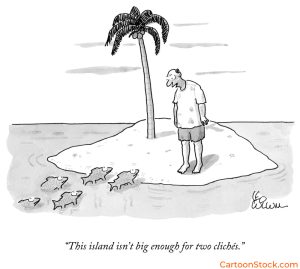
Cartoon critics Phil Witte and Rex Hesner look behind the gags to debate what makes a cartoon tick. This week our intrepid critics take a look at Desert Island Cliché.
A novelist’s greatest anxiety is the blank page. Cartoonists are similarly afflicted when their drawing paper remains stubbornly empty. There is a refuge for stumped cartoonists, however: the cartoon cliché.
The guru on a mountaintop, somber Easter Island heads, Noah’s Ark, and the police line-up are a few of the dozens of examples of the cartoon cliché. The great advantage of a cartoon cliché is its immediately recognizable situation: it essentially tells half the joke. All that remains is adding a killer caption and a few details to illustrate a thematic variation. But beware, the more common the cliché, the more difficult to find that unique twist.
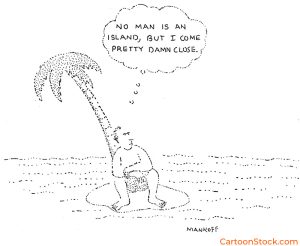
By far the hoariest cliché of all is the Desert Island scenario. The ingredients rarely vary: a tiny island, a single palm tree, limitless ocean, and one or more castaways. Former New Yorker Cartoon Editor, Bob Mankoff, takes his turn, with a literary nod to John Donne.
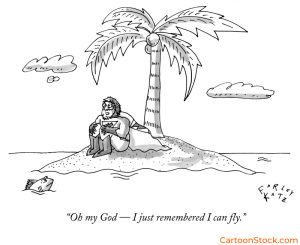
Once the desert island environment is established, the cartoonist has many avenues to explore. Farley Katz has chosen to depict the primary goal of many a castaway—escape. His twist? What if the marooned person possessed super powers?
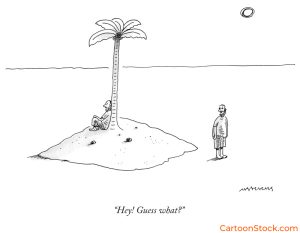
A second castaway adds another dimension to the desert island setup. Mick Stevens’ characters can now converse with each other and make an astonishing discover, while the image plays on our expectations.
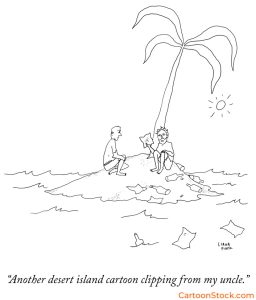
Liana Finck mixes this durable theme with another cartoon cliché: the message in a bottle. We get a sense of unexpected depth when the bottle improbably contains, yet again, a reference to a desert island cartoon. These are the plot contortions cartoonists must invent to achieve originality with such a well-worn trope.
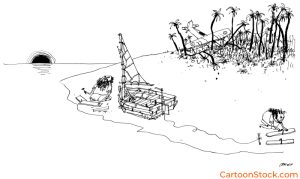
Eschewing one of the most consistent desert island elements–a tiny island completely surrounded by water–Edward Steed creatively conveys isolation through visual storytelling. A crash-landed biplane leaves no question as to how these castaways arrived. The landscape contour at sunset suggests we’re looking at half the island. And the water skis behind the escape boat? Madness.
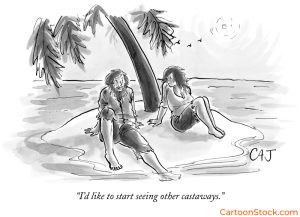
Now that we’ve established the two-castaway concept, what if they were of the opposite sex? Despite the apparent attractiveness of Carolita Johnson’s marooned female, the male has an irrational whim.
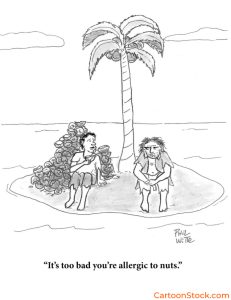
Stranded on an island with a single palm tree brings pangs of hunger to many readers. Coconuts might temporarily fill that void, unless of course, one has dietary restrictions. Blog co-author, Phil Witte, explores that angle with an unusually fecund palm tree.
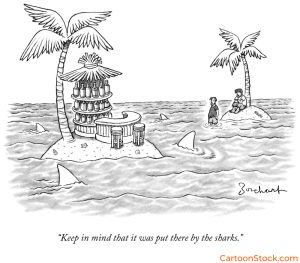
It’s always Shark Week on a desert island, and their cunning knows no bounds. David Borchart introduces a second island to place a fully-stocked tiki bar just out of reach of our thirsty duo. Long beards and tattered clothes hint at the duration of their exile and abstemiousness.
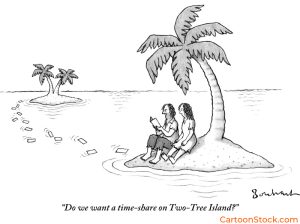
David Borchart ups the ante on the previous cartoon by not only showing an additional island, but one with two palm trees. The pamphlets floating toward the only possible readers is a brilliant graphic touch.
Our last three cartoons gleefully mix clichés with abandon. Joe Dator couldn’t resist addressing the classic radio station cliché question: “What 10 records would you bring to a deserted island?”. The resulting cartoon gives that question a reality check.

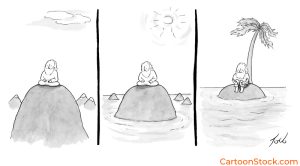
Tom Toro misleads us by beginning his triptych with the venerable guru-on-a-mountain cliché. Over the next two panels, he morphs that cliché into an inventive new hybrid, the guru-on-a-desert-island.” It’s a visual delight needing no caption.
Our final cartoon is a clever cliché “stand-off” from the imperishable Leo Cullum. Looks like the “evolving fish” cliché didn’t stand a chance against the timeless desert island.