

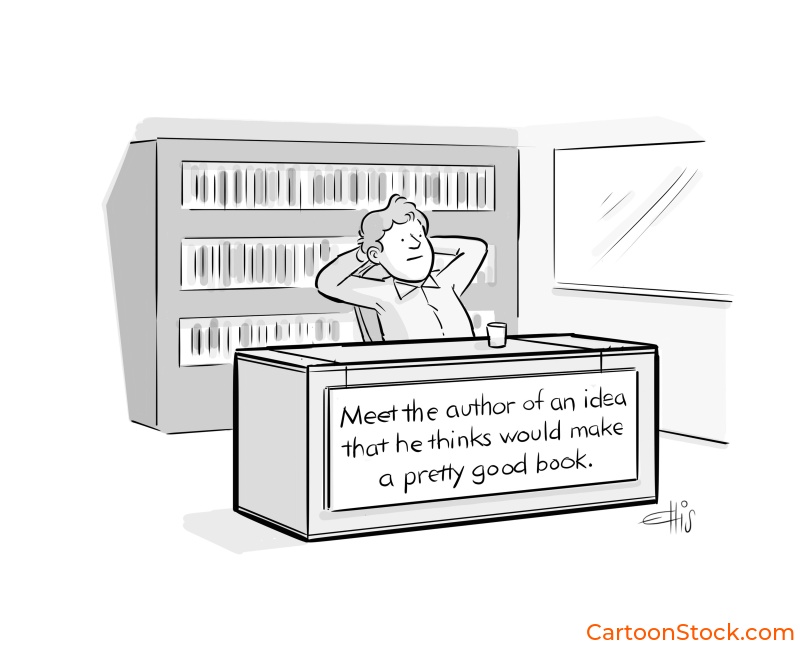
Want to use a cartoon in your book? Good choice. A well-placed cartoon can make a dense chapter readable, give a serious point a lighter way in, and leave your reader smiling. You’ll need a license, and getting one is straightforward. At CartoonStock we license cartoons to authors of every kind of book, from first-time self-publishers to academics and nonfiction writers. This guide walks you through the whole process in the order you’ll need it, with a link to the full post on each step.
Not sure yet whether cartoons belong in your book? See Cartoons in nonfiction: making a complex subject readable.
Why every cartoon in your book needs permission
Every cartoon has someone behind it: the cartoonist who drew it, or their estate. Putting it in your book is a use of their work, so it needs permission, whatever your print run and however you found the image. A cartoon online with no watermark or credit still belongs to someone.
A license is how you get that permission, and it does three useful things at once. It covers your specific use, it pays the cartoonist, and it gives you paperwork to show your publisher.
Do I need permission to use a cartoon in my book? covers this in full, including what to do if a cartoon is already in your book without a license.
Decide who holds the license
Before anyone buys, agree who is licensing: you, your publisher or a picture researcher. Our licenses are non-transferable, so a license bought by one party can’t be handed to another later. Settling this early saves you paying twice, or discovering that nobody paid at all.
Your publishing contract usually answers the question. Who handles image permissions, the author or the publisher? walks through each arrangement and what we need from whoever is licensing.
How a book license works
A standard publication license covers one book, at one print run band, in one territory. The cartoon runs inside the book at less than half a page. The license never expires, and it pays the cartoonist every time. Here’s what goes into it:
- Print run. Licenses come in five bands, from 1–5,000 copies up to 1,000,001 and above. Count printed copies and ebook downloads together, over the life of the edition. Don’t know your print run yet? Choose the band your best realistic estimate falls into. If you sell more, you move up and pay only the difference. Which license size to choose when you don’t know your print run explains how to estimate.
- Territory. Choose worldwide, or everywhere outside the US and Canada. If the book will sell in the US or Canada at any point, including through an online store, choose worldwide.
- Formats. Your print license covers the ebook when it carries the same content in the same context. A reprint that stays inside your band needs nothing more. A new edition needs a new license.
- Changes. You’re welcome to change the caption font to fit your layout. Anything else just needs our written agreement first.
Licensing for your kind of book
Licensing works the same way for every book. What changes is which decisions take the most thought.
Self-published authors get to make every call themselves, from counting print-on-demand copies to choosing a territory for online sales. Using cartoons in a self-published book takes each decision in turn.
Academic authors often use cartoons as evidence, clear their own permissions and publish in small print runs. Trade authors tend to have larger runs and more interest in covers and marketing. Licensing cartoons for trade and academic books covers both.
Covers and promotion
Want a cartoon to do more than sit inside the book? Two uses go beyond a standard license, and both are easy to arrange.
On the cover. A cartoon on the front of your book needs a custom license, quoted for your book. Talk to us before the design is final, since cropping a cartoon or placing the title over it needs our agreement. See using a cartoon on a book cover.
In your promotion. Social posts, websites, newsletters and adverts are separate uses from the book, so they need their own license. Can I use the cartoon when promoting my book? explains the options.
Keep your paperwork handy
At checkout you’ll receive a PDF listing the cartoon ID and every detail of your license: the use, the print run band, the territory and the term. That one document answers most of what a publisher’s permissions log asks. Keep a copy even if your publisher bought the license, because you stay with the book through every edition.
Filling in your publisher’s permissions log goes through the log column by column.
Eight questions before you license
Eight quick questions set every license: who is licensing, how many copies, where the book sells, which formats, where the cartoon sits, whether anything changes, whether there’s a translation or new edition, and whether you’ll use it to promote the book. Answer them first and you’ll license the right cartoon at the right size. Questions to ask before licensing a cartoon turns them into a checklist.
Where to start
It really comes down to a few decisions: who holds the license, how many copies to cover, where the book sells, and where the cartoon appears. Get those right and the rest follows. Then comes the fun part: choosing from more than 750,000 cartoons by over 1,000 cartoonists, knowing every license pays the person who drew it.
Licensing cartoons for publishing · Ask us about your book
Q&A: Cartoon licensing for authors
Q: I’ve never licensed an image before. Where do I start?
A: Find the cartoon on our site, note its ID, and work through the eight questions above. If your book doesn’t fit neatly into a category, email us and we’ll help.
Q: Can I license a cartoon before the book is finished?
A: Yes. License on your best estimate of the print run and tell us if it changes. For covers or any change to the cartoon, ask us before you license.
Q: Can you help me find a cartoon on my subject?
A: Yes, and we enjoy it. Email us with the point the cartoon has to make in your book. The emphasis of the joke usually matters more than what appears in the drawing.
Q: My book will be translated. Does that change anything?
A: A translated caption needs our approval before it’s printed, and your license needs to cover the translated edition’s territory.