

Do cartoons belong in nonfiction? Yes, and they often make it better. A good cartoon gets a reader to relax, smile and pay attention, which is exactly what a dense subject needs.
Stephan Weinberger and David Katz put that to the test in Smart Investing in Real Life, their plain-English book about investing. It’s about as serious as subjects get, and cartoons appear throughout. We asked Stephan how he chose them, where they went, and what the book would have lost without them.
If you’re thinking about cartoons for your own book, our guide to licensing cartoons as an author covers the practical side.
Explaining money to people who don’t speak finance
The book draws on more than 40 years of managing money, but it’s written for readers with none of that background. Stephan and David pictured their audience as anyone from 18 to 80-plus: educated, curious, and unfamiliar with financial jargon.
Plain English was the goal from the start, and it helps that Stephan was an English major before he went into finance. He often thinks of a scene in the 1993 film Philadelphia, where Denzel Washington, playing a lawyer, asks a witness to explain things as if to a child. The book isn’t written for children, of course, but the principle stuck. Even so, investing has a vocabulary of its own, and words alone can only do so much.
That’s where the cartoons came in. Stephan has loved them for years, and has been clipping them from newspapers and magazines for almost as long.
“It is an incredible talent to capture a thought so brilliantly with a picture and a caption, and they can tell a story in a way nothing else can.”
The book gave him the chance to use them properly: to help tell the story and make it, in his words, “more entertaining and accessible.”
One cartoon can do what a paragraph can’t
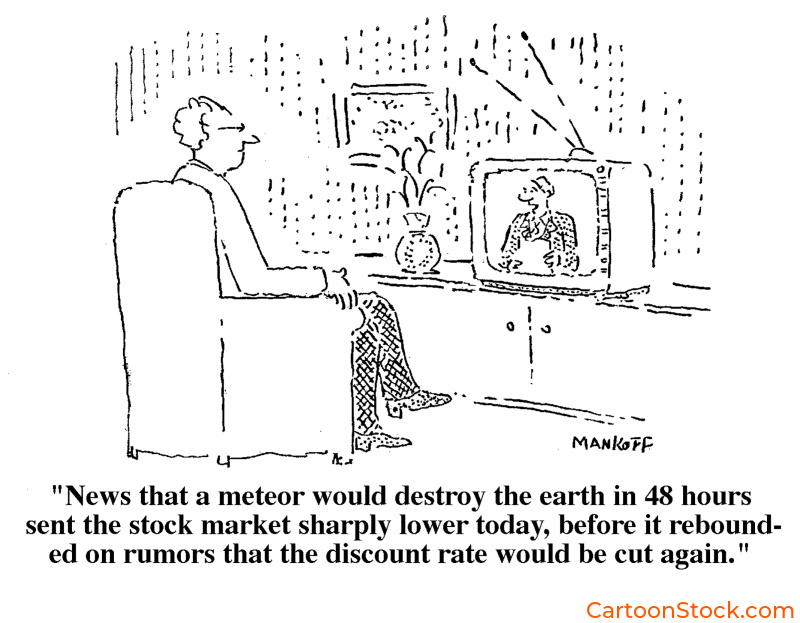
One of Stephan’s favorites is a Bob Mankoff cartoon he saved years ago, and it now sits framed on a bookshelf in his office. A man watches the news as the anchor reports that the market fell sharply on word that a meteor will destroy the earth in 48 hours, then rebounded on rumors of another rate cut.
It’s a perfect picture of investor psychology, and Stephan puts the case for it better than we could:
“A paragraph could describe how irrational markets can be. That cartoon makes you feel it in about three seconds.”
That’s the trick a good cartoon pulls off. It delivers the idea and the feeling at the same time, so the reader recognizes the point instead of having to be talked into it.
Stephan and David chose every cartoon in the book, and they’re quick to say they love them all. Two more favorites: Harley Schwadron’s Social Security and Medicare office, advertising for a Ph.D. in theoretical mathematics to explain the drug plan options, and Engleman’s police lineup, where suspect number two is asked to step forward and promise you can’t lose on a stock.
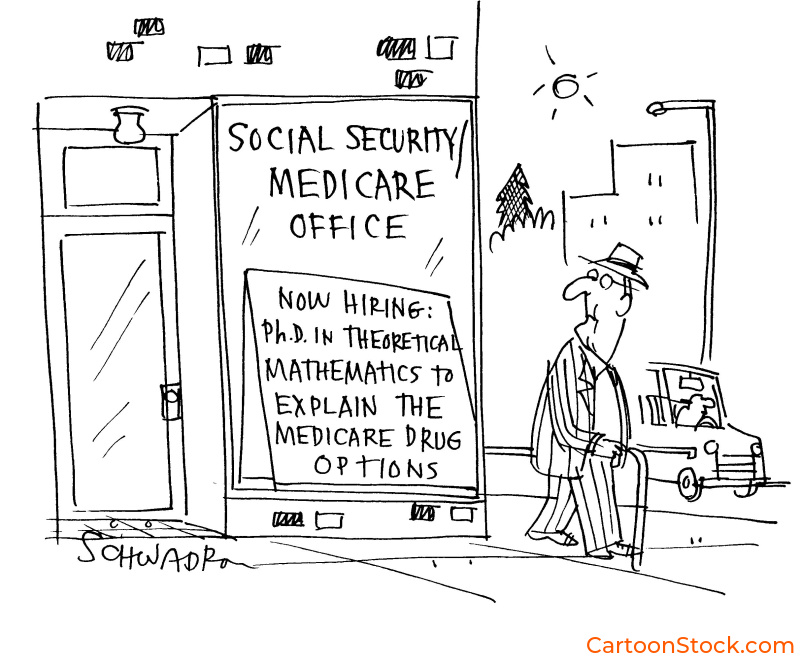 Cartoon by Harley Schwadron
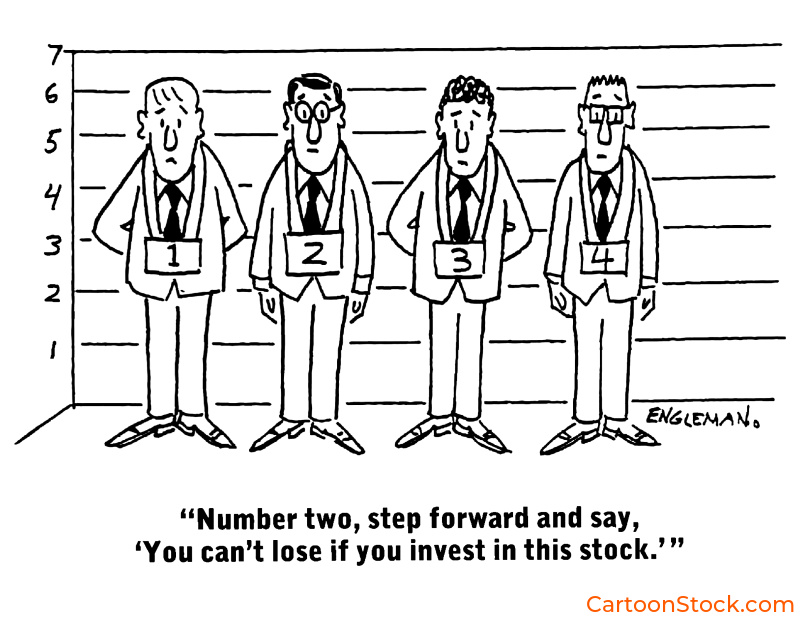
Both, Stephan says, “express a sentiment everyone gets right away, and leave you smiling.”
Be picky, and don’t force it
Stephan and David looked at more than 1,000 cartoons for the book, and they were choosy. Every candidate had to pass two tests:
- It had to appeal to them personally.
- It had to fit the theme of the chapter it was going into.
Plenty of good cartoons failed one or the other, and those didn’t make it. Some favorites Stephan had saved for years made the cut, and like every cartoon in the book, they were licensed before they went to print. (If you’re wondering whether that step applies to you, our post on whether you need permission to use a cartoon in your book has the short answer.)
As for placement, the cartoons ended up everywhere: chapter openers, breaks after heavier sections, and right beside particular ideas. Stephan and David would have liked one for every chapter, but they weren’t willing to shoehorn one in. Every cartoon in the book sits where it does because it belongs there.
Can’t find the one you want? Ask
Of everywhere Stephan looked, our site was, in his words, “by far the best resource.” A few he went looking for, though, he couldn’t find.
So he asked. Our team tracked them down, including the Mankoff and Engleman cartoons above.
“[Our team] tracked down cartoons I love and could never have found on my own.”
Looking for a specific cartoon?
This is something we do for authors and publishers all the time. If you have a particular cartoon in mind, or just an idea you want illustrated, tell us the topic and what kind of book it’s for, and we’ll search the collection for you. Get in touch through our publishing page.
Should you use cartoons in nonfiction?
We asked Stephan what he’d tell another author writing about a weighty subject.
“Do it if it feels right to you. Investing is a serious subject, and the cartoons made our book more accessible, not less serious. A good cartoon gets a reader to relax, smile, and pay attention, and that’s often when the penny drops. Just be picky: every cartoon should earn its place.”
And what would the book have lost without them?
“It would be a different book. The cartoons add wisdom with humor in a way only cartoons can, and they make the book a more enjoyable read.”
Making cartoons work in your own book
Cartoons don’t make a serious book less serious. They make it readable. Stephan’s approach is a good one to borrow: choose cartoons you genuinely love, make sure each one fits where it sits, and license them before you print. If the one you want is hiding somewhere, ask us to find it.
- Ready to start? See how licensing works on our publishing page.
- Want the details first? Read our guide to licensing cartoons as an author.
About the authors
Stephan Weinberger, CFA, and David A. Katz, CFA, of Matrix Asset Advisors have been talking about investing for more than four decades. Smart Investing in Real Life is available on Amazon in paperback and ebook, with an audiobook too. The preface and first chapter can be read on the book’s website.