

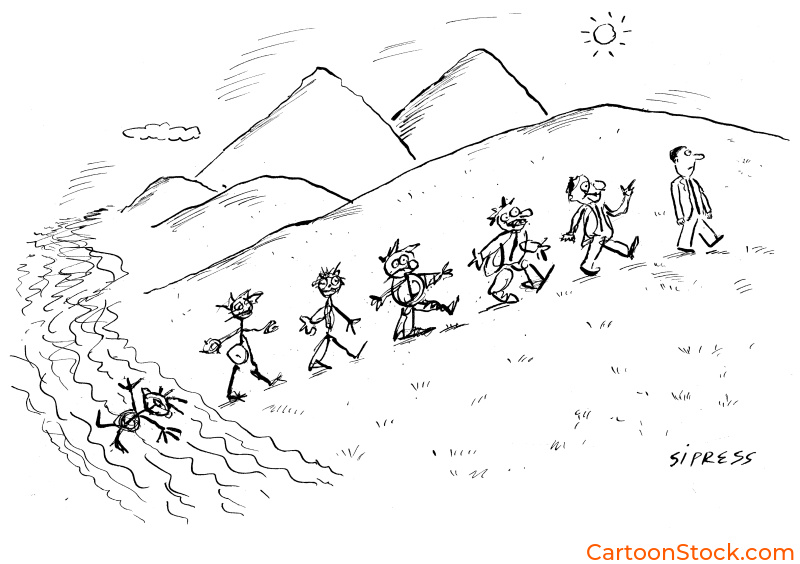
Cartoon by David Sipress, CartoonStock.
Cartoons in language learning give learners a reason to talk. Working out what’s happening in a cartoon, and why it’s funny, takes description and opinion, which is much of what a speaking or writing task is trying to get from a class. Cartoons are also quick to read and easy to remember, so they suit warm-ups, lead-ins, revision and short tasks between longer activities.
This post is part of our full guide to Cartoons in English Language Teaching (coming soon).
Getting a class talking
Early classes and new groups are often the hardest to get started. A single-panel cartoon on the screen gives everyone the same thing to look at, and learners usually have something to say about it even before they have all the vocabulary. Some will get the joke straight away and others won’t, and explaining it to each other is useful practice in itself.
For materials writers, a cartoon at the start of a unit can do several jobs at once. It can introduce the topic, give learners vocabulary to work with and set up a discussion question, all from one image slot.
Why cartoons in language learning work differently from photos
Photos are good for vocabulary. A stock image of a kitchen will get you “fridge,” “table” and “cooking.” A cartoon of a kitchen usually adds a situation. In one from our catalog, a couple stand in the kitchen doorway while giant ants eat cereal at the table, read the paper and make pancakes, and one of them says, “O.K., now I’m noticing that we have ants.” The vocabulary is all still there, but learners also have to work out what’s going on and why the line is funny. That asks more of their English than naming objects does.
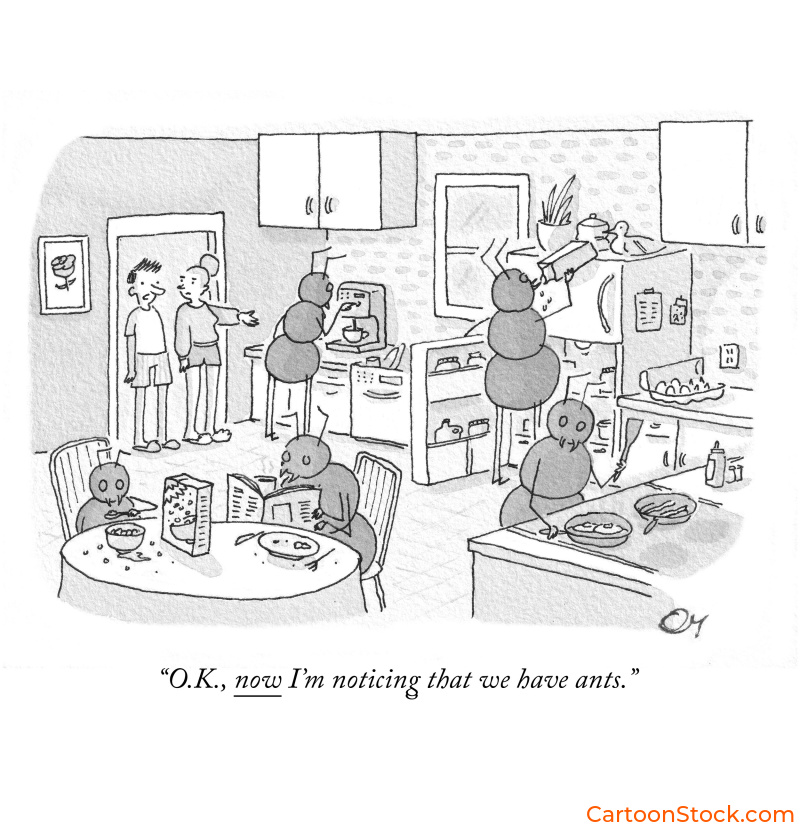
“O.K., now I’m noticing that we have ants.” Cartoon by Dan Misdea, CartoonStock.
The same cartoon works at more than one level. At A2, learners can describe what the ants are doing and what’s strange about it. At B2 or C1, they can talk about understatement and why “now I’m noticing” is the funny part. Cartoons also leave room for different readings, so two learners can interpret one differently and both have a reasonable case, which makes for a better discussion than an image with one obvious answer. Matching Cartoons to Learner Level (coming soon) goes into this in more detail.
How ELT publishers use cartoons
CartoonStock’s licensing records give a practical view of cartoons in language learning materials. ELT publishers rarely license the same cartoon twice. Nearly every cartoon they choose is a different one, which suggests cartoons are picked for individual units and topics rather than reused as general illustration.
The topics vary with the type of material. Global coursebooks mostly use everyday subjects such as pets, families, doctors, phone calls and language, which keeps them well away from the PARSNIP topics most international titles avoid. Publishers in Germany and Austria are more likely to license cartoons about social media, AI, climate and migration, which are common discussion and writing topics in upper-secondary English. Editorial cartoons are a regular part of what these publishers choose.
Both kinds of cartoon give learners something to respond to, and each suits different materials. Everyday Topics That Work in Any Classroom (coming soon) and Describe, Interpret, Comment: Cartoon Analysis in Upper-Secondary English (coming soon) look at them in turn.
Ways to use cartoons in speaking and writing tasks
Cartoons are short enough to fit into most parts of a unit, which is one reason cartoons in language learning materials are so flexible. Some of the ways they’re used:
- opening a unit, with learners guessing the topic
- pair work where each learner explains the cartoon to their partner
- covering the caption so learners write their own, then comparing it with the original
- describing what happened before the scene, or what happens next
- as the prompt for an opinion paragraph or short essay
- building a topic vocabulary set from what’s in the scene

Cartoon by Michael Crowford, CartoonStock.
Wordless cartoons are particularly useful for these tasks because learners produce all of the language. Wordless Cartoons for Speaking and Writing Tasks (coming soon) covers them separately.
Choosing humor that works for learners
Cartoons for ESL and EFL materials work best when the humor comes from familiar situations like work, pets, technology or family life. The joke shouldn’t depend on accents or language mistakes, so learners can enjoy the cartoon without feeling they’re the subject of it.
Wordplay can be harder. A pun that depends on a particular idiom may not make sense to learners in another country, so cartoons where the humor is visual tend to travel better. Choosing Cartoons That Travel: Humor, Idioms and International Classrooms (coming soon) has more on this.
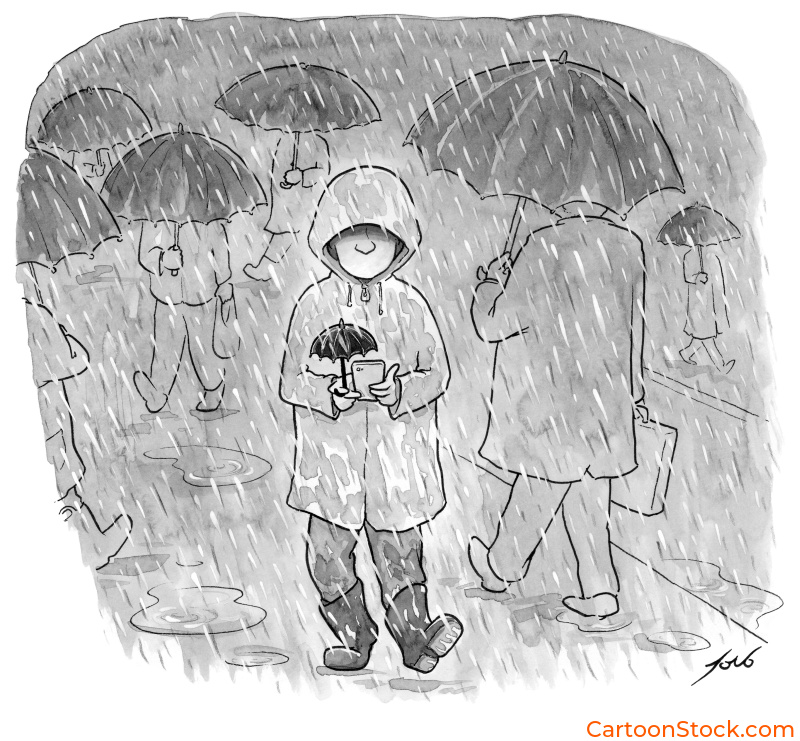
Cartoon by Tom Toro, CartoonStock.
Finding cartoons for ELT materials
If you’d like to try cartoons in language learning materials of your own, CartoonStock has more than 750,000 cartoons to search. The ELT collection (coming soon) brings together cartoons selected for English language teaching, and the cartoons for English language teaching page (coming soon) shows how they’re used in coursebooks, exam preparation and classroom resources.
Our team can also help you find the right cartoons. A lot of the ELT requests we receive come from picture researchers and permissions agencies working on a publisher’s behalf, as well as from editors directly. Whoever is asking, it helps to tell us the topic, level and type of material. The publishing page explains how licensing works for books and other publications.
Need cartoons for an ELT unit?
Tell us what you’re working on. Our team is always happy to help.
Frequently asked questions
Do cartoons work with adult learners as well as teenagers?
Yes. Cartoons about work, money, relationships and technology suit adult general English and business English classes, and adult learners often bring more of their own experience to a cartoon.
How do I get permission to use a cartoon in an ELT coursebook?
You license the cartoon for the publication it’s going into. Once it’s licensed, you can build any task you like around it. The publishing page explains how permissions work for books, and our team can help if you’re clearing several images for the same title.
Can CartoonStock help find cartoons for a specific unit?
Yes. Get in touch with the topic, level and kind of material, and our team will help. It can save time when you have lots of image slots to fill.
Related posts
- Wordless Cartoons for Speaking and Writing Tasks (coming soon)
- Choosing Cartoons That Travel: Humor, Idioms and International Classrooms (coming soon)
- Matching Cartoons to Learner Level (coming soon)