

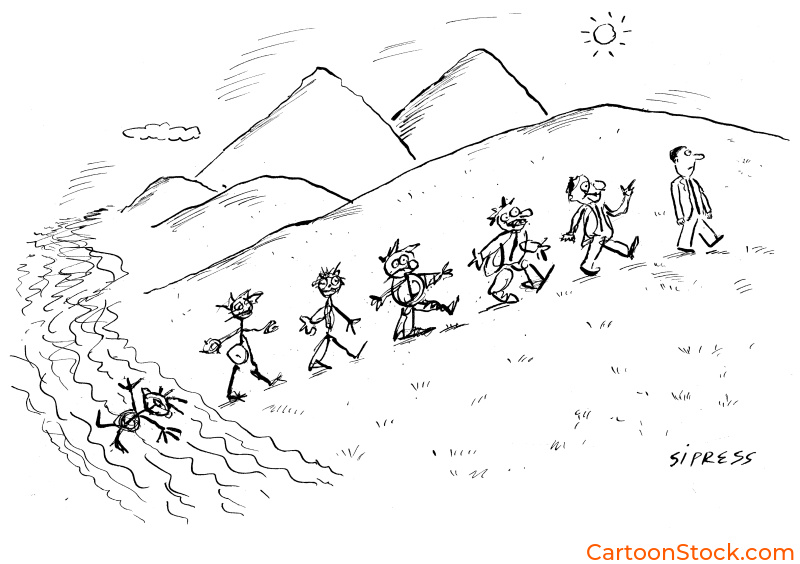
Cartoon by David Sipress, CartoonStock.
The best cartoons for international classrooms are the ones whose humor comes from situations people everywhere recognize, such as pets, family life, work and technology. Idioms, wordplay and jokes that depend on one country’s politics or customs can still be useful in ELT materials, but they tend to work best when understanding the joke is the task rather than something learners have to get past first.
This post is part of our full guide to Cartoons in English Language Teaching (coming soon).
What travels well
Cartoons built on everyday situations tend to work in almost any market. A dog that has chewed every shoe in the closet or a meeting that has gone on far too long needs very little explanation, wherever learners are. That makes everyday situations the natural place to start when you’re choosing cartoons for international classrooms.
CartoonStock’s licensing records reflect this. As we covered in why cartoons work in language learning, global coursebooks mostly choose everyday subjects such as pets, families, doctors and phone calls. Those topics also sit comfortably outside PARSNIP, which matters for titles sold in many countries at once.
Visual humor travels particularly well. When the joke is in what you can see, learners don’t need to share a cultural reference or a variety of English to get it, which is one reason wordless cartoons are so useful in international materials.
Cartoons that need inside knowledge
Some cartoons only work if you know how things are done in one particular country. Jokes about US party politics, the legal system, therapy culture or dating apps often rely on assumptions that learners elsewhere don’t share.
Our licensing records suggest ELT publishers are well aware of this. Those subjects rarely appear in what they license. When publishers in Germany and Austria do choose cartoons about US or UK politics, they tend to pick ones that make sense from outside the country, built around a widely recognized figure or a widely reported issue rather than the detail of party politics.
That doesn’t rule out culture-specific cartoons altogether. In upper-secondary materials, a cartoon about another country can be the starting point for a discussion about that country. When you’re selecting cartoons for international classrooms, it helps to decide in advance whether the cultural knowledge is part of what learners are meant to work out.
Idioms: obstacle or opportunity?
A caption that depends on an idiom can stop lower-level learners in their tracks. In a global coursebook at A2 or B1, that usually means choosing a different cartoon.
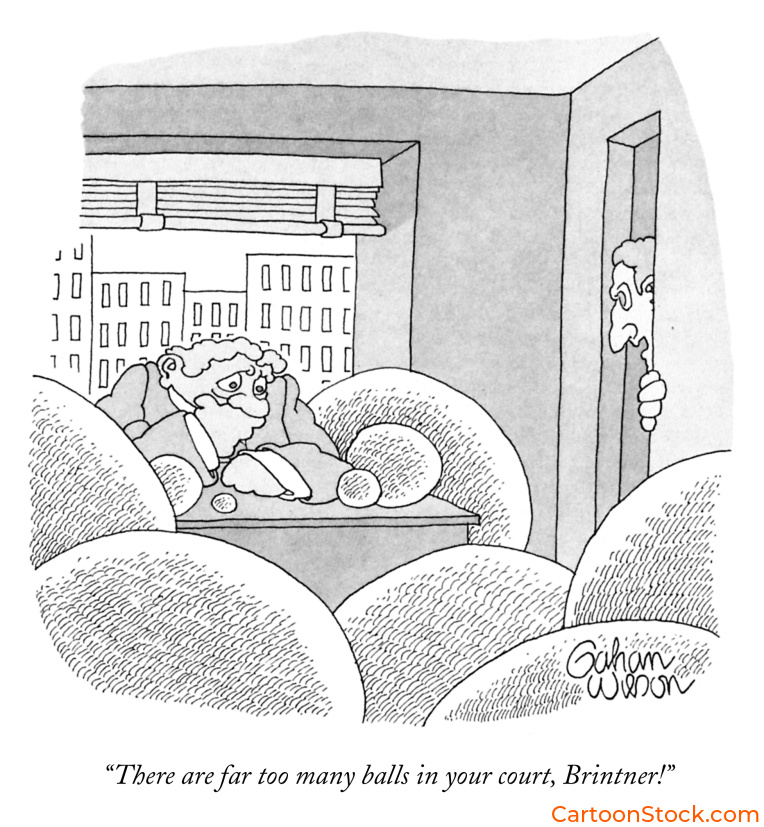
At B2 and above, the same thing can be an advantage. Cartoons that take an idiom literally give learners a picture to attach the phrase to, and working out the gap between what the words say and what they mean is good practice in itself. A cartoon captioned “There are far too many balls in your court, Brintner!” gives learners plenty to unpick. Cartoons About Language: Grammar, Vocabulary and Misunderstandings (coming soon) looks at this kind of cartoon in more detail.
Wordplay and puns
Puns work on the same principle. If learners need to recognize a double meaning before the cartoon makes sense, it’s worth asking whether explaining the pun is the aim of the task. If it is, a pun can make a memorable vocabulary point. If the cartoon is there as a lead-in or a quick discussion prompt, a joke that relies on the picture will usually work better.
Quick checks before you choose
A few questions help when you’re choosing cartoons for international classrooms:
- Would the joke make sense to someone who has never visited the country it comes from?
- Does it depend on a holiday, sport, food or custom that isn’t widely known?
- Does the caption use spelling or vocabulary that matches the variety of English in your title?
- Does it name a public figure or event that might date before the next edition?
- For titles sold in many markets, does it stay clear of PARSNIP topics?
- Is the humor about the situation, never about accents, language mistakes or nationalities?
Some outside knowledge is so widely shared that it’s rarely a problem. A cartoon of a panda waiting while a whole bamboo plant goes through a juicer assumes learners know what pandas eat, which most will.

Finding cartoons for international classrooms
CartoonStock has more than 750,000 cartoons, with plenty of everyday and visual humor alongside cartoons on idioms and current issues. The ELT collection (coming soon) brings together cartoons selected for English language teaching, and the cartoons for English language teaching page (coming soon) shows how they’re used in coursebooks, exam preparation and classroom resources.
If you’re choosing cartoons for a title that will be sold in several markets, our team can help. The publishing page explains how licensing works for books and other publications.
Need cartoons for an ELT unit?
Tell us what you’re working on. Our team is always happy to help.
Frequently asked questions
What does PARSNIP mean in ELT publishing?
PARSNIP is shorthand for the topics many global coursebooks avoid: politics, alcohol, religion, sex, narcotics, isms and pork. Cartoons about everyday life, such as pets, family and work, usually sit well outside it.
Do cartoons with American captions work in British English materials?
Often, yes, but it’s worth checking spelling and vocabulary against the variety of English your title uses. If consistency matters, a wordless cartoon avoids the question altogether.
Are idiom cartoons suitable for lower-level learners?
They usually work better from B2 upward, where learners can enjoy the gap between the literal picture and the real meaning. At lower levels, everyday visual humor tends to be the safer choice.
Related posts
- Why Cartoons Work in Language Learning
- Wordless Cartoons for Speaking and Writing Tasks
- Cartoons About Language: Grammar, Vocabulary and Misunderstandings (coming soon)