

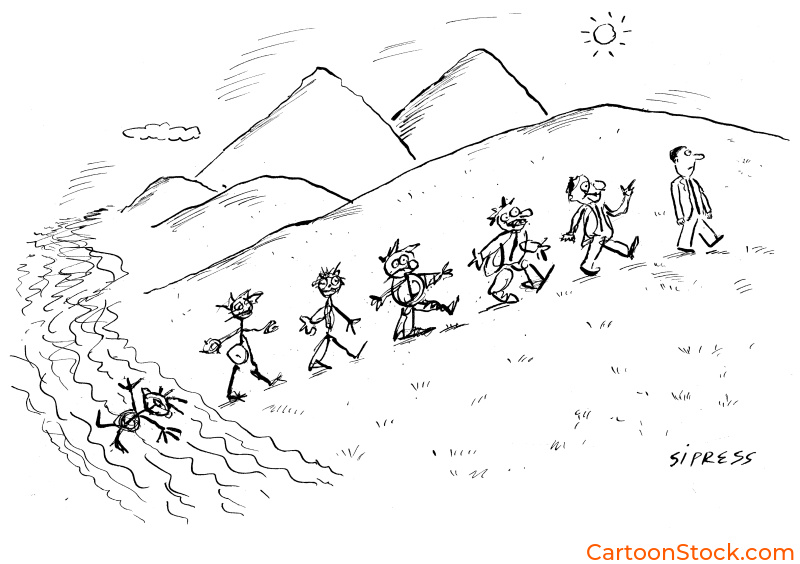
Wordless cartoons are some of the most flexible images you can use for speaking and writing tasks, because learners supply all of the language themselves. With no caption to read, everyone in the class can access the cartoon, and the same image can support a simple description at A1 or A2 and a story, an argument or a piece of writing at B2 and above.
This post is part of our full guide to Cartoons in English Language Teaching (coming soon).
Why wordless cartoons suit ESL and EFL learners
A captioned cartoon asks learners to read and understand the joke before they can talk about it. Wordless cartoons skip that step. Learners start with what they can see, which makes them a good fit for mixed-level groups, where stronger and weaker learners can work with the same image and still have something to say.
They also avoid the problems that captions can cause in international classrooms. There’s no idiom to explain and no pun that only works in one variety of English, so wordless cartoons tend to work across markets without much adaptation. Choosing Cartoons That Travel: Humor, Idioms and International Classrooms (coming soon) looks at this in more detail.
For materials writers, there’s another advantage: the language learners produce is entirely their own. That makes a wordless cartoon useful wherever you want to see what learners can actually say, rather than how well they’ve understood someone else’s words.
Speaking tasks that work with wordless cartoons
Most speaking tasks built around pictures will work with a wordless cartoon. Some options:
- pairs each describe a different cartoon to their partner, then compare
- one learner describes the cartoon while the other draws it or picks it out from a set
- learners discuss what happened just before the scene and what happens next
- small groups act out the scene and invent the dialogue
- learners take sides on the issue a cartoon raises and argue their case
The humor is useful here too, since working out why a scene is funny gives learners a real reason to explain, disagree and ask each other questions, which is harder to get from a neutral photo.
Writing tasks built on wordless cartoons
Because there’s nothing to copy, wordless cartoons also make good writing prompts. Learners could write a caption or speech bubbles and then vote on the best one, write the scene as a short narrative, or write a paragraph from the point of view of one of the characters.
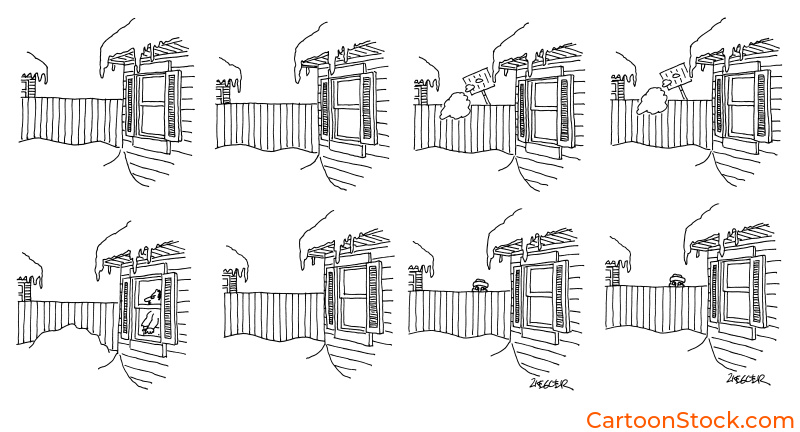
Wordless strips are especially useful for narrative writing. A sequence of panels gives learners a ready-made structure to describe in the past tense, with sequencing words to link each stage. In one wordless strip from our catalog, a man clears the snow from his side of the fence by throwing it into his neighbor’s yard, where the pile keeps growing. Learners can narrate what happens, then write the neighbor’s reply.
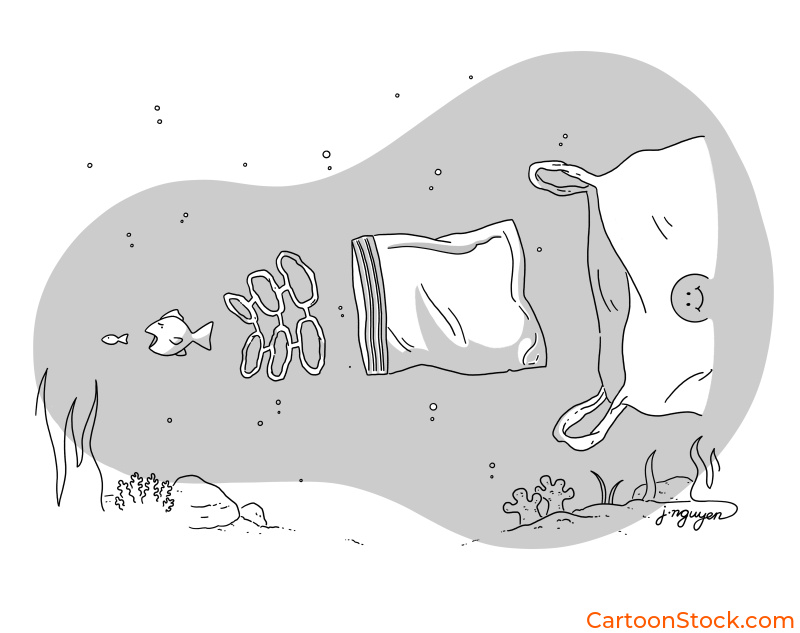
At higher levels, wordless cartoons on issues such as the environment or technology work well as prompts for opinion paragraphs and short essays. Learners need to interpret the cartoon’s point before they can agree or disagree with it, and without a caption they have to do that interpretation themselves.
Single panels or strips?
Both work, but they suit different tasks. A single-panel wordless cartoon captures one moment and leaves the rest open, so it’s well suited to speculation: what happened before, what happens next, and what the characters might be thinking. A strip shows a sequence, which makes it better for narrating and ordering events, though it answers some of those questions for the learner.
For prediction tasks a single panel usually gives learners more room, while a strip is often the better choice for retelling.
What to look for in a wordless cartoon
The most useful wordless cartoons for ELT materials tend to have a few things in common:
- one clear main action that reads at a glance
- no small details the joke depends on, so it still works when printed small
- no props or customs that only make sense in one country
- a topic that fits the unit, so the cartoon also brings in useful vocabulary
For titles sold in many markets, it’s worth keeping the same topics in mind that you would for any image. As we found when we looked at why cartoons work in language learning, global coursebooks mostly choose everyday subjects such as pets, families and home life.
A captioned cartoon can also become a wordless one for a lesson: covering the caption lets learners work with the image first and compare their ideas with the original afterward.
Finding wordless cartoons for ELT materials
CartoonStock has more than 750,000 cartoons, including wordless single panels and strips on everyday subjects and on the issues learners are asked to discuss. The ELT collection (coming soon) brings together cartoons selected for English language teaching, and the cartoons for English language teaching page (coming soon) shows how they’re used in coursebooks, exam preparation and classroom resources.
If you’re looking for wordless cartoons on a particular topic, our team can help. The publishing page explains how licensing works for books and other publications.
Need cartoons for an ELT unit?
Tell us what you’re working on. Our team is always happy to help.
Frequently asked questions
Are wordless cartoons suitable for beginners?
Yes. Beginners can name what they see, say what people are doing and give simple opinions, all without needing to read anything first. The same cartoon can then be reused later in a course for longer speaking or writing tasks.
Do you have wordless cartoons on serious topics as well as everyday ones?
Yes. Alongside everyday scenes, the catalog includes wordless cartoons on subjects such as the environment and technology, which suit discussion and opinion writing at higher levels.
How do I license a wordless cartoon for ELT materials?
In the same way as any other cartoon: you license it for the publication it’s going into. The publishing page explains how permissions work for books, and you can get in touch if you’d like help finding the right cartoons.
Related posts
- Why Cartoons Work in Language Learning
- Choosing Cartoons That Travel: Humor, Idioms and International Classrooms (coming soon)
- Matching Cartoons to Learner Level (coming soon)